
The water sector is currently lacking comparable structures. The EU regulatory framework for water reuse focuses primarily on water quality, treatment, and risk management, rather than collective governance models.
However, climate change is exacerbating water stress in Southern Europe, and it also increases the occurrence of extreme weather events such as droughts, heatwaves, and floods. Water scarcity is now a crucial social issue that demands urgent political action.
The policy brief ‘From energy to water communities: How umbrella entities can enable community-based water management in the Mediterranean‘, drafted by the 3rd Institutional Policy Dialogue, provides an overview of the current situation in Mediterranean countries and identifies barriers and opportunities to develop water communities. The document recommends first adapting the energy sector’s umbrella entities, and then designing and funding local projects to build citizen engagement.
Water management in the Mediterranean
Currently, in the Mediterranean countries, water management is organised through a mix of public utilities, municipal operators, regional or basin authorities, mixed public-private arrangements, and concession-based systems. Institutional models vary across countries, but water management mainly relies on utility-centred governance models, with limited space for community-led initiatives.
Irrigation associations and communities, particularly in Spain, offer some forms of collective water management. Local cooperatives and user associations in rural and remote areas are also common.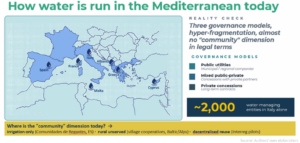
Yet, despite these experiences, none of these arrangements corresponds to a recognised water-community model comparable to the Renewable Energy Community or Citizen Energy Community concepts established under European energy legislation.
As a result, community participation in water management exists in practice, but lacks a common institutional identity, dedicated regulatory support and clear rights and responsibilities. In particular, the absence of legal recognition creates two challenges. First, citizens, municipalities, and local stakeholders lack a dedicated institutional vehicle through which to establish and operate water communities. Second, existing water governance systems have not yet evolved to integrate such arrangements into broader service provision and planning frameworks.
To overcome these barriers, the 3rd Institutional Policy Dialogue explored whether umbrella entities, inspired by the experience of the energy sector, could help bridge this gap by providing shared technical expertise, legal guidance, governance support and capacity-building services to emerging initiatives.
For starters, to support the creation of water communities, the policy brief suggests adapting the umbrella model to fit the water sector context. An umbrella entity is an independent intermediary structure that provides shared technical, legal, financial, and organisational support to local initiatives. It can support the development of water communities by reducing implementation barriers and pooling expertise, and, in a later stage, fostering the active participation of citizens.
Recommendations to address barriers and tensions
The development of water communities faces many obstacles. Regulations, public health and water quality standards, financing, lack of infrastructure, relationships between stakeholders, social acceptance, and data monitoring represent barriers that need to be taken into account by legislators, public funders, municipalities, and utilities.
The 3rd Institutional Policy Dialogue has identified the following recommendations:
- Create an EU legal framework, establish a common working definition to legally recognise water communities
- Inverted setup scene, creating first support mechanism to design viable projects before forming local citizen groups
- Technical suitability does not apply to uses that do not involve potable water, as drinking water services have stricter quality and public health standards
- Collaboration over institutional competition, promoting combined schemes
- Integrating community water projects into existing platforms, using the existing legal and administrative frameworks of energy communities and umbrella entities
- Taking advantage of current European policy, as the European Water Resilience Strategy and national reforms in countries such as France and Spain are being discussed