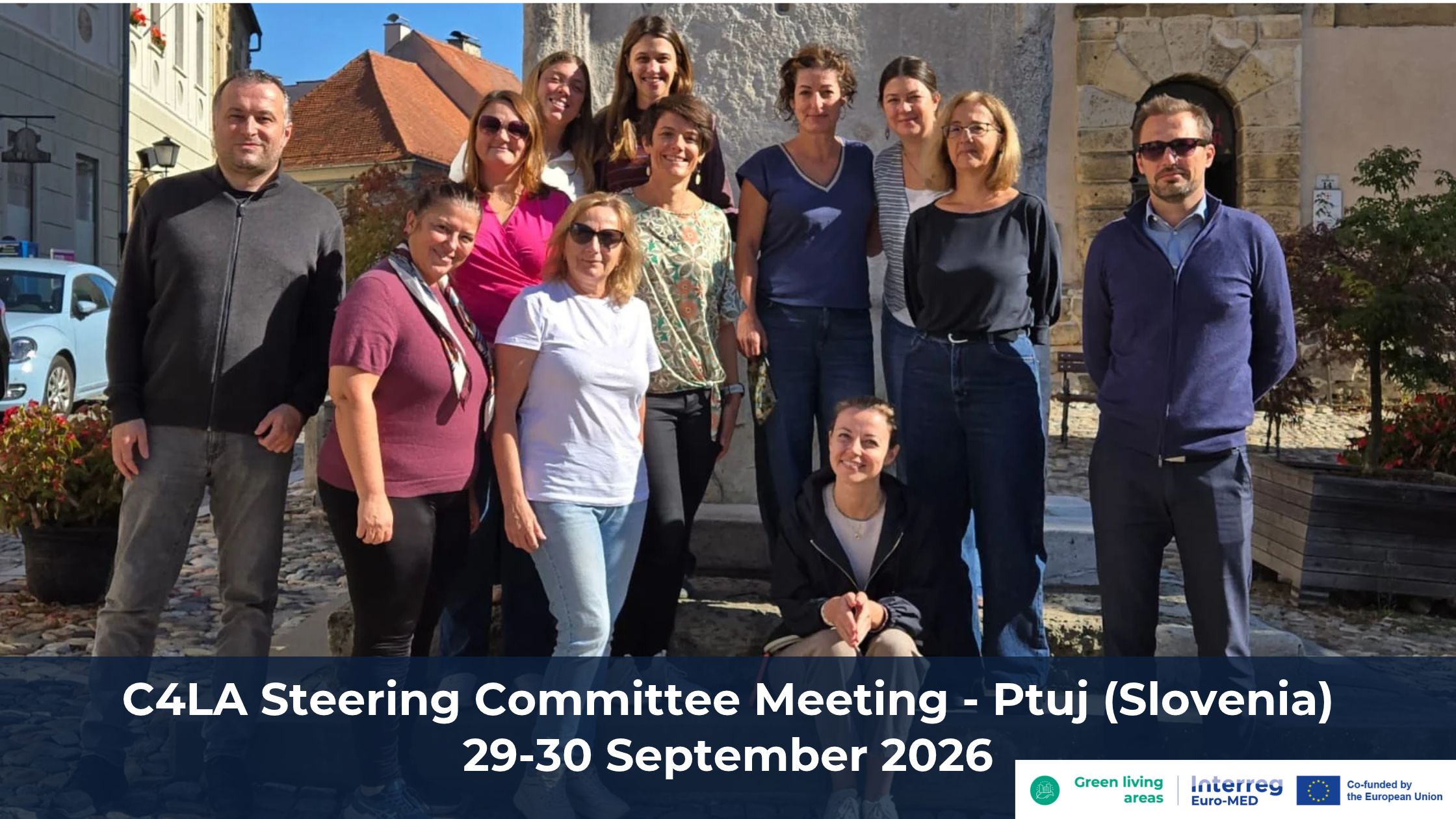

On 29–30 September 2026, partners of the Community4LivingAreas (C4LA) project gathered in Ptuj, Slovenia, for their annual Steering Committee meeting. Hosted by Bistra, the meeting provided an important opportunity to review progress across the project and, above all, prepare the Green Living Areas Mission for a key new phase: supporting the transfer and uptake of tested solutions in new Mediterranean territories.
As many Thematic Projects reach maturity, an increasing number of solutions developed and tested across the GLA Mission are becoming ready to move beyond their original pilot territories. Ensuring that the most promising of these solutions can be adapted, replicated and taken up elsewhere is therefore becoming a central priority for the Mission.
Identifying solutions with strong transfer potential
A key focus of the Steering Committee was the review of solutions emerging from across the Green Living Areas community. C4LA partners worked together to identify solutions with the strongest potential for transfer to other Mediterranean territories, considering their maturity, relevance and potential for adaptation to different territorial contexts. This work will feed into a first catalogue of Green Living Areas solutions selected for the transfer, making it easier for local and regional authorities to discover practical approaches that could respond to challenges in their own territories. The meeting also provided an opportunity for partners to fine-tune the Mission’s transfer mechanisms and discuss how solution providers can be connected with territories interested in adopting their approaches.
From tested solutions to transfer through ETU
The Ecosystemic Transition hUb (ETU) Initiative will play a central role in this next phase, providing a framework to showcase tested solutions, connect solution providers with potential takers and support their adaptation and implementation in new contexts. The next important milestone will be ETU Call 2, expected to open in November 2026. Through the call, local and regional authorities will be invited to identify solutions they would like to explore for their territories and apply for dedicated support for their transfer and adaptation, working together with the organisations behind the solutions. The Ptuj Steering Committee therefore marked an important step in the Mission’s evolution: from developing and testing solutions to creating the conditions for their wider uptake and impact across the Mediterranean.
Stay tuned: the first catalogue of solutions and further information about ETU Call 2 will be available soon.