
Inland and rural areas across the Mediterranean share a common pattern of decline driven by economic marginalisation and demographic shifts. These territories often lack the financial resources and technical expertise required to implement large-scale regeneration strategies.
The BAUHAUS4MED model responds to this gap by reframing regeneration not as a purely physical transformation, but as a governance process rooted in collaboration. It builds on the principles of the New European Bauhaus—sustainability, inclusion and aesthetics—to reconnect planning with local needs and cultural identity.
In this new brief, once again resulting from the fruitful discussions of the 2nd Institutional Policy Dialogue of the Green Living Areas Mission, we discuss the takeaways from the BAUHAUS4MED experience in Minucciano, a small municipality in the Italian region of Tuscany.
A pilot experience in Minucciano
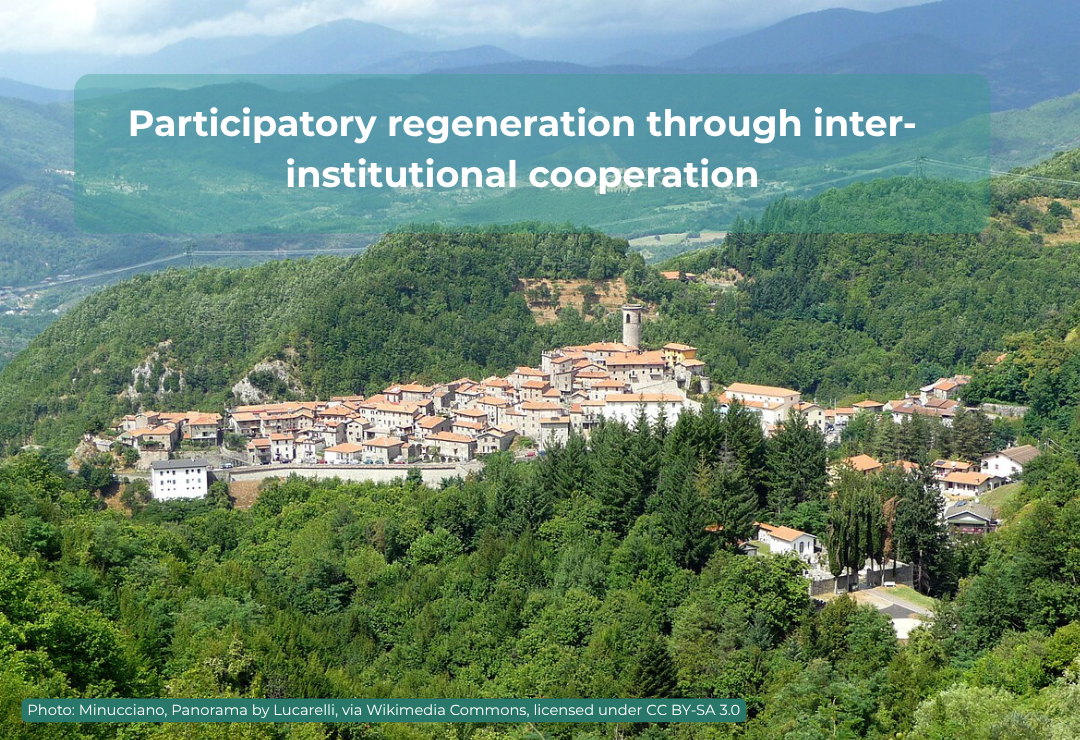
The Italian municipality of Minucciano, located in Tuscany’s inner Garfagnana area, served as a testing ground for this approach. Facing depopulation and socio-economic decline, the municipality became the centre of a collaborative regeneration process involving:
- Regional authorities (Region of Tuscany)
- Local government (Municipality of Minucciano)
- Academia (University of Florence – DIDA)
- Private sector actors
- Local communities
This multi-level partnership was formalised through an inter-institutional agreement, transforming participatory experimentation into a structured governance framework
At the core of the model is a strong emphasis on citizen engagement. Through participatory methods such as “World Café” workshops, residents actively contributed to identifying local needs, challenges and opportunities.
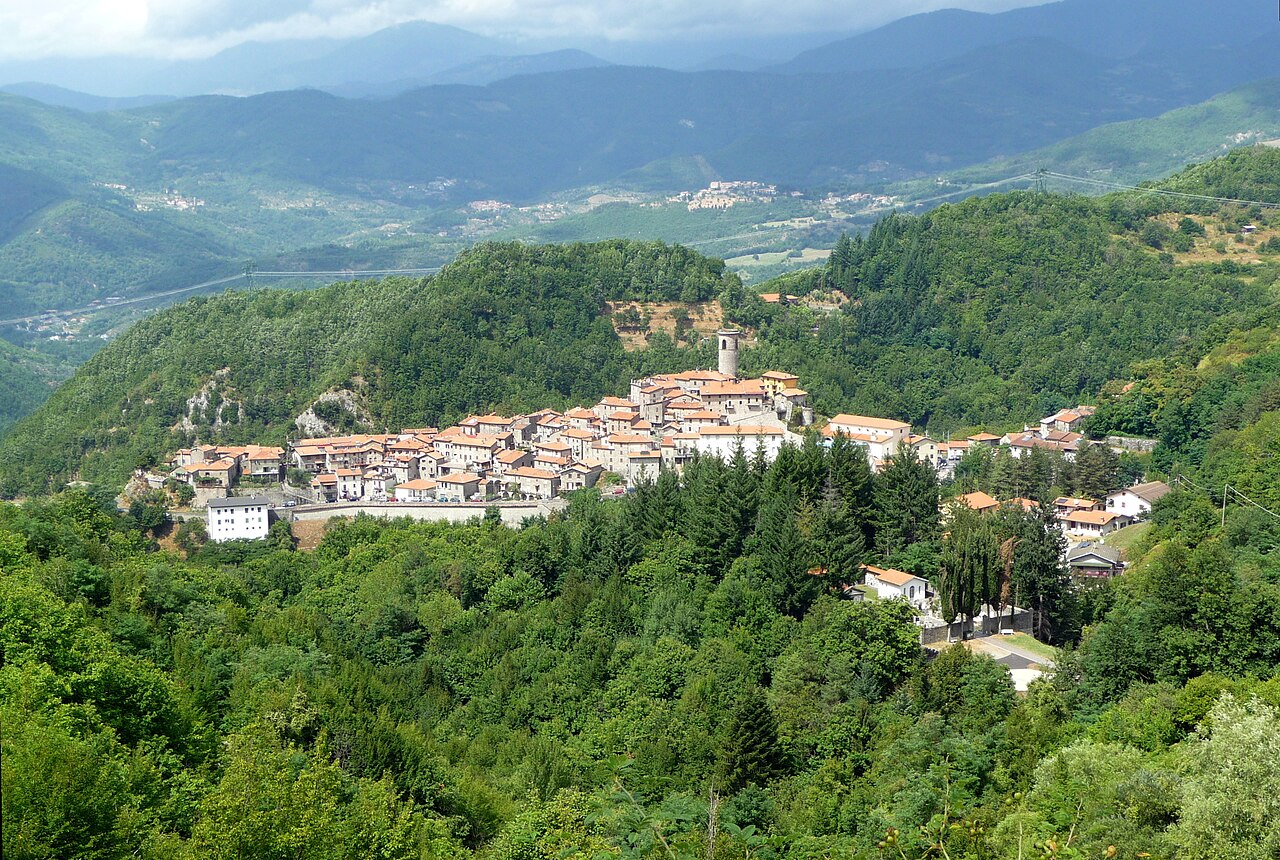
Photo: Minucciano, Panorama by Lucarelli, via Wikimedia Commons, licensed under CC BY-SA 3.0
These inputs were then translated into concrete design proposals by university students specialising in sustainable architecture, ensuring that local knowledge and technical expertise were effectively combined.
The process not only generated innovative solutions but also strengthened community ownership and trust, which are key ingredients for long-term success.
Beyond project funding: new financing approaches and replicability
One of the main barriers to regeneration in small territories is the lack of sustainable funding beyond project cycles. The BAUHAUS4MED model addresses this by combining participatory governance with alternative financing mechanisms.
In Minucciano, local private enterprises played an active role by supporting community initiatives as part of their social and environmental responsibility. At the same time, digital tools such as the CROWDVOCACY platform enabled citizens to vote on and co-finance local projects, blending online and offline participation.
Enablers and barriers to scaling up
While the model shows strong potential, several challenges remain. These include:
- Administrative complexity and bureaucratic barriers
- Limited technical capacity in small municipalities
- Citizens’ scepticism towards new initiatives
- Difficulty accessing stable funding sources
To overcome these obstacles, the policy brief highlights key enablers such as integrated planning, strong political commitment, capacity building and multi-level cooperation. Support from regional and EU programmes is also essential to provide guidance, simplify procedures and facilitate knowledge exchange.
Towards a new paradigm for territorial regeneration
The BAUHAUS4MED model illustrates how participatory regeneration can evolve from a local experiment into a transferable policy approach. By embedding collaboration into formal governance structures, it bridges the gap between community-driven initiatives and institutional decision-making.
For Mediterranean regions, sustainable regeneration is not only about projects, but about building long-term systems based on trust, cooperation and shared responsibility.