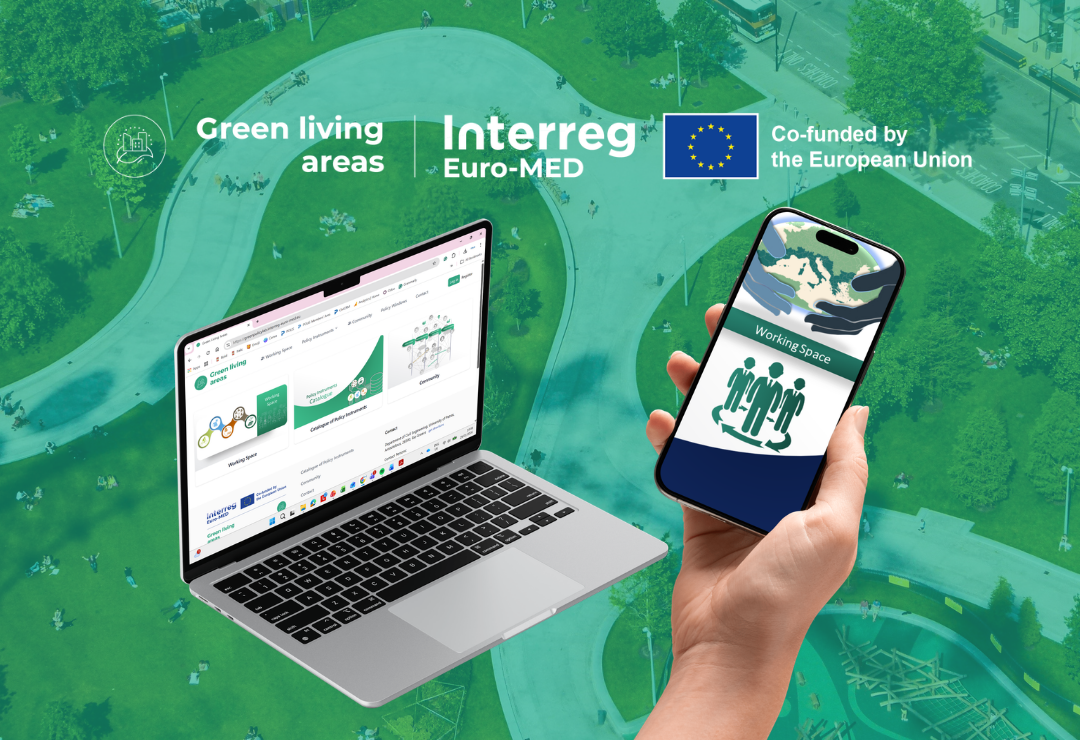

The Green Living Areas Mission is proud to introduce the Green Policy Lab—a new, free, community-driven platform designed to catalyse collaboration, innovation, and policy action across the Mediterranean. Conceived as both a forum and a knowledge repository, the Lab provides an integrated digital space where policymakers, experts, practitioners, and community stakeholders work side by side to shape the future of sustainable territories.
Part of the Mission’s Institutional Dialogue framework, the platform builds on the principles of co-creation, evidence-based policymaking, and multi-stakeholder engagement, translating dialogue into practical solutions for greener living areas.
From ambition to action: Five thematic working spaces
At the heart of the Green Policy Lab lie five thematic working spaces, each dedicated to a core dimension of sustainable urban and territorial development:
- Green mobility (people & goods): Focusing on sustainable urban transport, logistics, and low-carbon mobility systems, this working space addresses policy pathways to cleaner, more accessible movement of people and goods.
- Green energy systems: Dedicated to renewable energy deployment, citizen energy communities, and energy transition governance, this space supports the shift toward decarbonised and resilient energy models.
- Green & climate-change resilient spatial planning: Here, stakeholders explore land-use strategies, climate adaptation planning, and integrated territorial development for resilient Mediterranean landscapes.
- Green community engagement: Recognising that sustainability transitions must be socially driven, this space promotes participatory governance, co-design processes, and citizen involvement.
- Financing the green transition: This working space tackles one of the most critical enablers of change: funding. It examines investment models, EU financing mechanisms, and innovative financial tools supporting green policies.
Across all five areas, participants identify key policy challenges; analyse evidence and good practices; co-create policy recommendations; and engage decision-makers through structured dialogues. The aim is to create a virtuous cycle of knowledge sharing, innovation, and implementation across Mediterranean territories.
A living repository of policy knowledge
Beyond dialogue, the Green Policy Lab hosts a structured Catalogue of Policy Instruments and Best Practices: a continuously expanding library of strategies, regulations, and initiatives that are shaping green living areas across the Mediterranean.
The repository is designed to serve as a practical knowledge hub where stakeholders can explore transferable policy models, examine how different regions approach similar challenges, and draw inspiration from successful instruments already in place. By facilitating comparison, exchange, and learning, it supports the replication and scaling of effective solutions.
By linking policy content with territorial context, the platform ultimately strengthens evidence-based decision-making and fosters more informed, place-sensitive policy development.
Seizing the moment: The power of policy windows
One of the Lab’s most innovative features is its Policy Windows tool, designed to help stakeholders recognise and act upon time-sensitive opportunities for reform.
Policy windows arise when political, social, or economic conditions align in ways that make policy change possible. The platform tracks and visualises these moments, ensuring that well-developed solutions can move forward when the timing is right. Such opportunities may emerge following political transitions—such as the election of a mayor open to bold mobility reforms—during EU funding cycles that unlock new investment capacity or in response to heightened public demand for cleaner air after pollution crises.
By identifying these strategic openings, the Green Policy Lab bridges the gap between policy design and real-world adoption, turning promising ideas into implemented action.
An open, inclusive community
Accessibility and inclusivity are central to the platform’s design. Public users can freely explore policy resources, follow discussions, and monitor developments, while registered members take a more active role by contributing content, sharing policy instruments, and engaging in thematic exchanges.
This layered engagement model ensures both transparency and meaningful expert collaboration, strengthening the Mediterranean policy ecosystem and fostering a shared sense of ownership over the green transition.
As Mediterranean territories face intensifying climate, mobility, and energy challenges, the need for coordinated policy innovation has never been greater.
The Green Policy Lab responds by offering a transnational collaboration space where stakeholders can connect, exchange tested policy solutions, and access tools that help identify concrete implementation opportunities. At the same time, it acts as a bridge between research and governance, ensuring that knowledge generated through projects and studies can effectively inform decision-making.
By transforming dialogue into deployment, the Lab enables Mediterranean cities and regions to advance as models of sustainability, resilience, and inclusivity.
More on how to use the platform:
Check out the manual here.