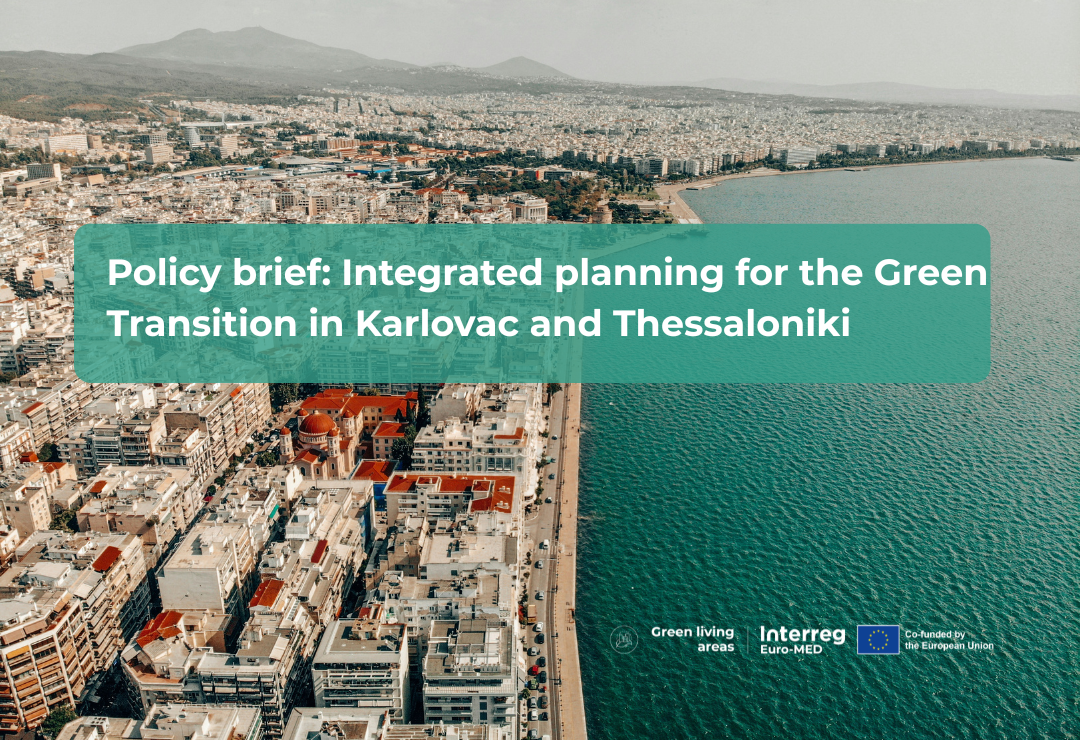

Mid-sized cities across Europe are emerging as key players in the transition toward climate neutrality. A new policy brief from the Green Living Areas Mission highlights how integrated, cross-sectoral planning is becoming a critical governance tool to address the complex and interconnected challenges cities face today, from climate change and energy transition to mobility, biodiversity loss, and social inequality.
This brief, titled ‘Integrated planning for the green transition: Karlovac (Green City Action Plan) and Thessaloniki (Climate Neutrality Action Plan)‘, is the result of the discussions held during the 2nd Institutional Dialogue of the Green Living Areas Mission. It presents integrated planning approaches implemented in the mid-sized cities of Karlovac (Croatia) and Thessaloniki (Greece) and key lessons derived from them. It is an example of how to include environmental priorities in urban strategies through integrated governance and structured investment pipelines.
Moving beyond fragmented planning
Traditional sector-based planning approaches are increasingly seen as insufficient. Urban challenges are systemic: decisions in one domain often have cascading effects across others. As a result, cities must adopt integrated planning frameworks that align spatial development with energy, mobility, climate, and circular economy objectives. The policy brief emphasises that integrated planning allows for the following elements:
-
- Stronger coordination across departments and governance levels
- Evidence-based decision-making through improved data availability
- The translation of strategic goals into concrete, financeable actions
- Greater policy coherence and long-term impact
This is why mid-sized cities occupy a unique position. They combine sufficient institutional capacity with greater flexibility than large metropolitan areas, allowing them to experiment with innovative governance and planning models. At the same time, they face constraints such as limited administrative resources and higher vulnerability to climate impacts. This combination makes them both laboratories for innovation and critical actors in scaling sustainable solutions across the Mediterranean region.
Two cities, two integrated approaches
Karlovac: Green City Action Plan (GCAP)
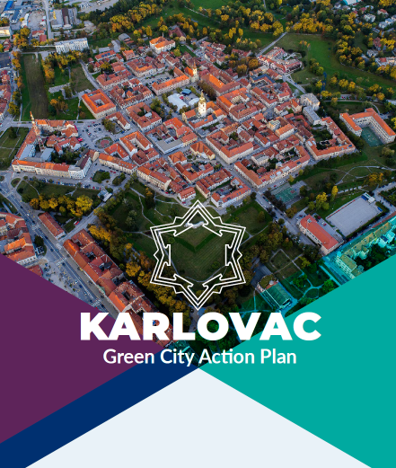
Karlovac’s Green City Action Plan (GCAP), adopted in 2024, demonstrates how environmental diagnostics can be transformed into a structured and investment-ready strategy.
The plan is built on a comprehensive baseline assessment covering sectors such as energy, transport, water, waste, and land use. Using a data-driven methodology, the city identified key challenges—including emissions from buildings and transport, flood risks, and gaps in infrastructure—and translated them into 24 priority investment actions worth approximately €245 million
Crucially, the GCAP links long-term sustainability objectives with a concrete project pipeline. This approach ensures that planning is not merely strategic but operational, enabling access to EU funding, national resources, and private investment.
Thessaloniki: Climate Neutrality Action Plan
Thessaloniki’s Climate Neutrality Pathway is structured around its Climate City Contract (CCC), supported by an Action Plan and Investment Plan. Together, these instruments define a clear roadmap for achieving climate neutrality.
A key strength of the Thessaloniki model lies in its governance structure. A dedicated municipal transition team coordinates implementation across departments while fostering collaboration with universities, businesses, utilities, and civil society. This multi-stakeholder approach enhances policy coherence and innovation while improving the city’s capacity to absorb EU funding.
Despite this progress, challenges remain, particularly in scaling projects, mobilising private investment, and strengthening data and monitoring systems.
Both cases demonstrate that integrated planning is not a fixed model but a set of transferable principles. However, replication requires adaptation to local contexts. Mediterranean cities must account for factors such as administrative fragmentation, socio-economic diversity, and climate vulnerability. Flexible governance models, intermunicipal cooperation, and diversified funding sources are essential for scaling these approaches.
A practical pathway to climate neutrality
The experiences of Karlovac and Thessaloniki are great examples of how integrated planning is not just a conceptual framework: it is a practical tool for delivering systemic change.
By linking strategy with investment, fostering cross-sectoral coordination, and embedding climate objectives into everyday governance, cities can move from fragmented actions to coherent transition pathways.