
Local energy communities are increasingly recognised as a key driver of Europe’s energy transition. By enabling citizens, municipalities and local stakeholders to collectively produce, manage and consume renewable energy, these initiatives contribute to decarbonisation while fostering social inclusion and local resilience.
However, despite growing momentum across Europe and the Mediterranean region, many energy communities still face significant barriers when it comes to scaling their initiatives. Limited technical expertise, complex governance frameworks and fragmented support mechanisms often prevent promising local projects from reaching their full potential.
These challenges were at the centre of discussions during the second Institutional Policy Dialogue of the Green Living Areas Mission, held in Brussels on 15-16 October 2025. The dialogue brought together policymakers, practitioners and experts from across the Euro-Mediterranean region to identify practical policy solutions that could accelerate the deployment and impact of energy communities. The dialogue highlighted successful and highly replicable policy instruments, including Catalonia’s OECOOP cooperative model, which supports energy communities through an umbrella structure. Discussions focused on how similar frameworks could be adapted and replicated across Mediterranean territories. The insights and exchanges from the event directly informed the recommendations that resulted in this policy brief, ensuring a practical and collaborative approach. The policy brief, titled ‘Enabling Local Energy: How Umbrella Entities Make Energy Communities Scalable and Replicable‘, is available in its full version here:
Energy communities and the transition to greener living areas
The Interreg Euro-MED Green Living Areas Mission aims to improve quality of life across Mediterranean regions by promoting sustainable urban development, climate resilience and citizen engagement. Within this framework, energy communities represent an important instrument for achieving both environmental and social objectives. Energy communities allow citizens, municipalities and local organisations to collectively generate renewable energy, often through solar installations or other local renewable sources. By sharing both the benefits and responsibilities of energy production, communities can increase energy independence, reduce greenhouse gas emissions and reinvest economic gains locally. Beyond their environmental benefits, these initiatives also strengthen democratic participation in the energy system. Citizens become active participants rather than passive consumers, while local authorities gain new tools to address challenges such as energy poverty and rising energy costs. Despite these advantages, scaling such initiatives across regions remains difficult without adequate structural support.
Why local energy communities struggle to scale
Many energy communities begin as grassroots initiatives, often driven by highly motivated citizens or forward-thinking municipalities. While these projects can succeed locally, replicating them across territories requires significant coordination and expertise.
Local actors frequently encounter several obstacles when developing or expanding energy communities:
-
Limited technical expertise for developing and managing renewable energy projects
-
Administrative and regulatory complexity, particularly when navigating national energy regulations
-
Difficulty accessing financing for initial investments or project development
-
Fragmented coordination between municipalities, citizens, utilities and other stakeholders
Without dedicated support structures, these challenges can slow down implementation and limit the ability of local initiatives to expand beyond pilot projects.
This is where umbrella entities can play a transformative role.
The role of umbrella entities
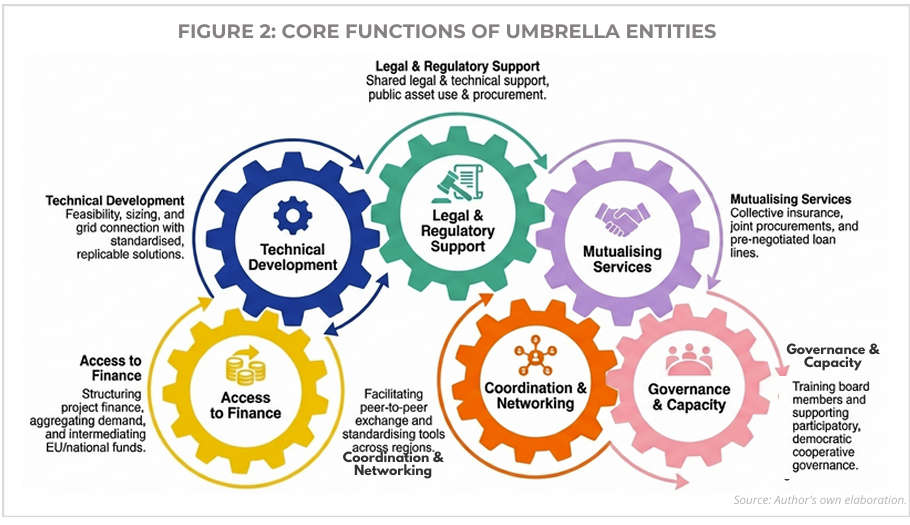
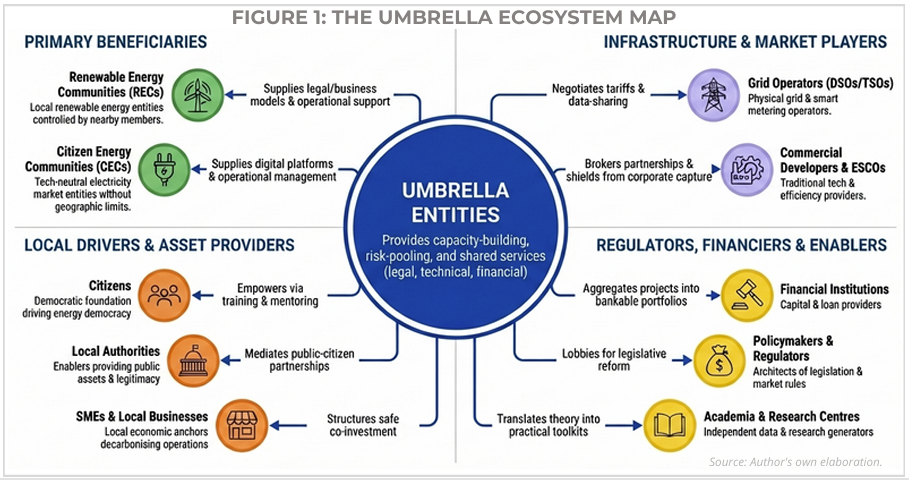 Umbrella entities act as intermediary organisations that support multiple local energy communities by pooling resources, expertise and organisational capacity. They can take various forms, including federations of energy cooperatives, second-level cooperatives, or specialised support platforms. By operating at a broader territorial or national level, umbrella entities can provide services that individual communities may struggle to deliver on their own. These organisations typically support energy communities through:
- Technical assistance, including guidance on project development, energy regulation and renewable technologies
- Administrative and governance support, helping communities manage legal structures and operational processes
- Knowledge sharing and replication, enabling successful models to be transferred to new regions
- Capacity building, supporting municipalities and citizen groups in navigating complex regulatory frameworks
In many cases, umbrella entities also serve as a bridge between local initiatives and higher levels of governance, connecting energy communities with funding programmes, policymakers and national energy strategies. By strengthening coordination and professional support, these organisations can significantly accelerate the growth and sustainability of local energy initiatives.
Policy recommendations for enabling umbrella entities
 The policy brief developed following the October 2025 dialogue outlines several recommendations to strengthen the enabling environment for energy communities and their supporting structures.
Recognise umbrella entities in policy frameworks
Public programmes and energy policies should formally recognise the role of umbrella organisations as key facilitators of community energy projects.
Provide long-term operational funding
Many umbrella entities rely heavily on short-term project funding. Multi-year financing mechanisms would allow them to provide continuous support to local initiatives.
Expand technical assistance programmes
Dedicated advisory services can help municipalities and citizen groups overcome regulatory, technical and financial barriers when establishing energy communities.
Strengthen multi-level cooperation
Closer collaboration between European institutions, national governments, regions and municipalities is essential to ensure coherent policy frameworks and effective support systems.
Together, these measures could create a more favourable environment for energy communities to thrive and expand across Europe.
Unlocking the full potential of community energy
Energy communities represent a powerful opportunity to transform the way energy is produced, distributed and consumed across Europe. They empower citizens, strengthen local economies and contribute directly to climate objectives.
Yet their success depends not only on local motivation, but also on the broader governance structures that support them. By recognising and strengthening the role of umbrella entities, policymakers can help bridge the gap between grassroots initiatives and large-scale energy transformation.
The discussions held during the Green Living Areas Institutional Policy Dialogue highlight that the transition towards more sustainable and resilient territories is already underway, and that community-driven energy solutions will play an increasingly important role in shaping Europe’s greener living areas.